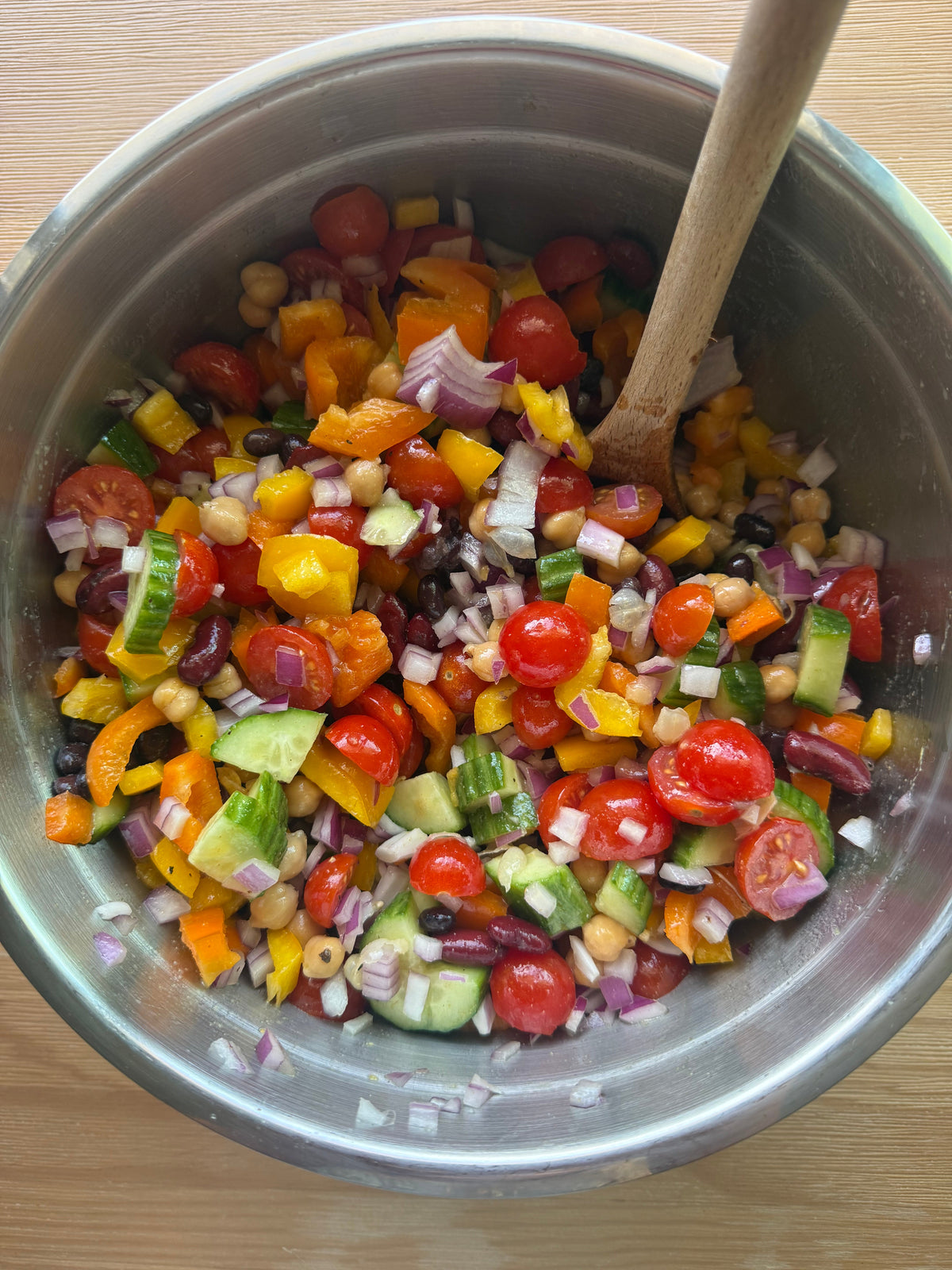
Let’s start with a fact that might be a gut punch: About 95% of adults don’t consume enough fiber every day. That means nearly everyone you know is falling short on one of the most essential nutrients for long-term health.
We’ve been taught to think of fiber as a digestive aid; the stuff that “keeps things moving.” But the truth runs much deeper. Fiber isn’t just about digestion. It’s the fuel that feeds your microbiome: the trillions of microbes living in your gut that drive everything from metabolism to mood regulation.
So when you’re not getting enough fiber, you’re not just missing out on smooth digestion. You’re starving the ecosystem that keeps your whole body in balance.
The Real Answer: How Much Fiber Do We Need?
Let’s get straight to the numbers.
According to the USDA and the National Academies of Sciences, the daily fiber recommendation is:
-
25 grams for women
-
38 grams for men
Yet, on average, adults only get 15 to 18 grams a day: barely half of what we need for optimal health.1
But here’s what those numbers don’t tell you: Fiber needs aren’t one-size-fits-all. They depend on your body, your diet, and your microbiome. Think of that 25–38 grams as a baseline. It’s the starting point for most people. If you’re already eating a plant-forward diet or following a high-protein lifestyle, your needs may differ. And aiming for higher than roughly 30 grams of fiber per day actually correlates with more health benefits and lessened disease risk.2
Here’s the key distinction, though: It’s not just about quantity, but diversity.
Why Fiber Diversity Is the Missing Link
You could technically hit your 30g-ish fiber threshold just by eating a bunch of broccoli. (6 cups, to be precise.) But you’d only be fueling some of your microbes… and in turn, only certain health benefits.
There isn’t just one kind of fiber. Each type of fiber feeds different microbial species, and each of those species produces unique compounds that impact everything from inflammation and immunity to mood, energy, and metabolism.
If your microbiome is a garden, fiber is the fertilizer. But not all fertilizer feeds every plant equally.
-
Soluble fibers (found in oats, chia, beans, and apples) dissolve in water and help feed beneficial gut bacteria.
-
Insoluble fibers (found in whole grains, veggies, and seeds) add structure. They help move waste through the digestive tract. Insoluble fiber is pretty easy to come by in the average diet, and because it’s minimally fermentable by your gut microbes, they require a less clinical approach.
-
Prebiotic fibers (like inulin, resistant starch, and beta-glucans) are the gold standard for microbiome health. These are the fibers your gut bacteria ferment into short-chain fatty acids (SFCAs): compounds that keep your gut lining strong, reduce inflammation, and even support brain health.3
Your Gut Has Its Own Geography
Your gut is home to a host of microbial species, and they all live in different neighborhoods of the colon. And not every fiber ferments in the same place… or at the same pace. Consuming diverse varieties of fiber ensures that you’re nourishing microbes in every region of your gut.
Fast-fermenting fibers get to work early in the colon, feeding early microbes and producing SCFAs that kickstart digestion.
Moderate-fermenting fibers sustain microbial activity in the transverse colon, producing SCFAs that strengthen the gut lining, regulate immunity, and stabilize blood sugar.
Slow-fermenting fibers reach later regions of the colon. These are complex fibers that fuel microbial growth, improve regularity, and ensure the full length of the gut thrives.
How To Tell If You’re Getting Enough Fiber
When your fiber intake is too low, you might notice:
-
Irregular digestion (constipation, bloating, or both)
-
Energy crashes after meals
-
Skin issues or dull complexion
-
Feeling full but not satisfied
-
Brain fog or low mood
On the flip side, when you’re getting enough (and the right mix) things start to shift:
-
Your digestion flows naturally
-
You feel more satiated after meals
-
Your energy is stable
-
Your mood feels more balanced (yes, gut bacteria help make serotonin!)4
Fiber isn’t a quick fix. It’s a slow, steady reset for your microbiome. The changes build quietly.
Is There Such a Thing as Too Much Fiber?
The average person is far more likely to be fiber-deficient than fiber-overloaded. That said, more isn’t always better, especially if you ramp up too fast or rely on a single fiber source.
Too much fiber (or too much of one kind) can lead to bloating, cramping, or gas: not because fiber is “bad,” but because your microbiome hasn’t yet adapted to digest it efficiently.
If you’ve ever suddenly added a ton of chia pudding or fiber supplements and felt uh, turbulent… that’s your gut bacteria signaling, “Hey, we need a minute.”
The solution is simple:
-
Start low and go slow. Increase your intake by five grams a week until you hit your goal.
-
Mix your sources. Combine soluble, insoluble, and prebiotic fibers from different plants: fruits, veggies, legumes, seeds, and whole grains.
-
Hydrate. Fiber absorbs water; staying hydrated keeps your digestion smooth and prevents discomfort.
The goal is to feed your gut thoughtfully and consistently.
How Can I Consume Enough Fiber?
In a perfect world, we’d all meet our fiber goals through a balanced, plant-rich diet. And honestly, that should still be the goal: to fill your plate with a rainbow of fruits, vegetables, seeds, and legumes. Here’s where your daily fiber can come from:5
-
Whole Grains: Oats, quinoa, barley, bulgur, farro, and brown rice. Each offers a mix of soluble and insoluble fibers that help regulate digestion and support blood sugar balance.
-
Vegetables: Leafy greens (like kale and spinach), cruciferous veggies (broccoli, Brussels sprouts, cauliflower), carrots, sweet potatoes, and artichokes are all fiber powerhouses. Plus, they deliver phytonutrients that feed beneficial gut bacteria.
-
Fruits: Berries, apples, pears, oranges, and bananas (especially slightly green ones) provide natural prebiotic fibers and polyphenols: two key ingredients for microbiome diversity.
-
Legumes + Pulses: Lentils, chickpeas, black beans, and edamame offer both soluble and insoluble fibers, along with plant-based protein to keep you full and your gut happy.
-
Nuts + Seeds: Chia, flax, hemp, and almonds are small but mighty: packed with fiber, omega-3s, and prebiotics that help nourish short-chain fatty acid–producing microbes.
- Root Vegetables + Resistant Starch Sources: Cooked-and-cooled potatoes, green plantains, and Jerusalem artichokes contain resistant starch: a special type of fiber that acts as food for beneficial gut bacteria.
The more categories you pull from each day, the richer and more resilient your gut ecosystem becomes.
Do I Need a Fiber Supplement?
The reality is that most of us can’t eat “perfectly” every day… and the numbers show that most of us aren’t. That’s where a fiber supplement can come in handy, if you know how to choose the right one.
Even the most intentional eaters fall short. Between rushed mornings, travel days, and takeout dinners, it’s easy to miss those 30 daily grams of fiber your body (and microbiome) needs to thrive. And even when you do make the effort, our modern food system doesn’t make it easy. Today’s produce contains less fiber than it did decades ago, and processed “healthy” foods are often stripped of the very plant fibers that keep our gut ecosystems flourishing.5
That’s where fiber supplementation steps in: not as a replacement for a healthy diet, but as a reinforcement. A tool to help bridge the gap between how we want to eat and what’s actually realistic every day.
But here’s the key: not all fiber supplements are created equal.
Most conventional products rely on a single fiber source (like psyllium husk), which is great for keeping things moving… but not so great for supporting your microbiome long-term. It’s a bit like watering one plant in a garden and expecting the rest to bloom.
The next evolution? Diverse, multi-fiber blends.
These blends are formulated with multiple prebiotic fibers: each one feeding a different family of beneficial bacteria in your gut. That diversity is what makes your microbiome resilient. It’s what helps balance digestion, metabolism, mood, and immune health, from the inside out. It’s the impetus behind creating LOAM.
So, do you need a fiber supplement? Not necessarily. But if your diet is missing variety, or if your digestion, bloating, or energy levels could use support, the right kind of supplement can help your microbiome do what it was designed to do: thrive.
REFERENCES:
-
Fernstrand, A. M., Bury, D., Garssen, J., & Verster, J. C. (2017). Dietary intake of fibers: differential effects in men and women on perceived general health and immune functioning. Food & nutrition research, 61(1), 1297053. https://doi.org/10.1080/16546628.2017.1297053
-
Alahmari L. A. (2024). Dietary fiber influence on overall health, with an emphasis on CVD, diabetes, obesity, colon cancer, and inflammation. Frontiers in nutrition, 11, 1510564. https://doi.org/10.3389/fnut.2024.1510564
-
Carlson, J. L., Erickson, J. M., Lloyd, B. B., & Slavin, J. L. (2018). Health Effects and Sources of Prebiotic Dietary Fiber. Current developments in nutrition, 2(3), nzy005. https://doi.org/10.1093/cdn/nzy005
-
Barber, T. M., Kabisch, S., Pfeiffer, A. F. H., & Weickert, M. O. (2020). The Health Benefits of Dietary Fibre. Nutrients, 12(10), 3209. https://doi.org/10.3390/nu12103209
-
Bhardwaj, R. L., Parashar, A., Parewa, H. P., & Vyas, L. (2024). An Alarming Decline in the Nutritional Quality of Foods: The Biggest Challenge for Future Generations' Health. Foods (Basel, Switzerland), 13(6), 877. https://doi.org/10.3390/foods13060877